
Trace Nelson County Former Owners Backward
Work backward from one known conveyance. Every deed row in a Nelson County property search should capture four things: the grantor, the grantee, the deed type, and the citation that powers the next lookup. The order matters. A worksheet like the one here keeps former owners in sequence without leaping between unrelated tracts.
| Transfer date | Grantor to grantee | Deed type | Book/page or file |
|---|---|---|---|
| Newest confirmed recording | Prior holder to present grantee | Copy the instrument's stated type | Save the exact citation |
| Next earlier recording | Earlier holder to the prior holder | Copy without assuming warranty | Save the exact citation |
| Earlier book entry | Repeat only after matching the land | Note special estate or court deed | Use clerk book and page |
Time order prevents confusion. The clerk's permanent records date to 1785. Online data and images, however, reach back only to 1977.
Separate Nelson County's 1977 Online Window From 1785 Records
The clerk's online-access FAQ gives the key limit: index data and images are available from 1977 forward and update every 30 minutes. The recording page separately states that permanent records date to 1785. Those dates describe two access eras, not a contradiction.
Use the online index to establish a reliable recent chain and legal description. Once a step reaches before 1977, ask the clerk which handwritten or typed index, deed book, or microfilm run continues it. No official source reviewed for Nelson County verified every older volume as digitized.
The official online-access FAQ is the source for the county's published date range and refresh statement.
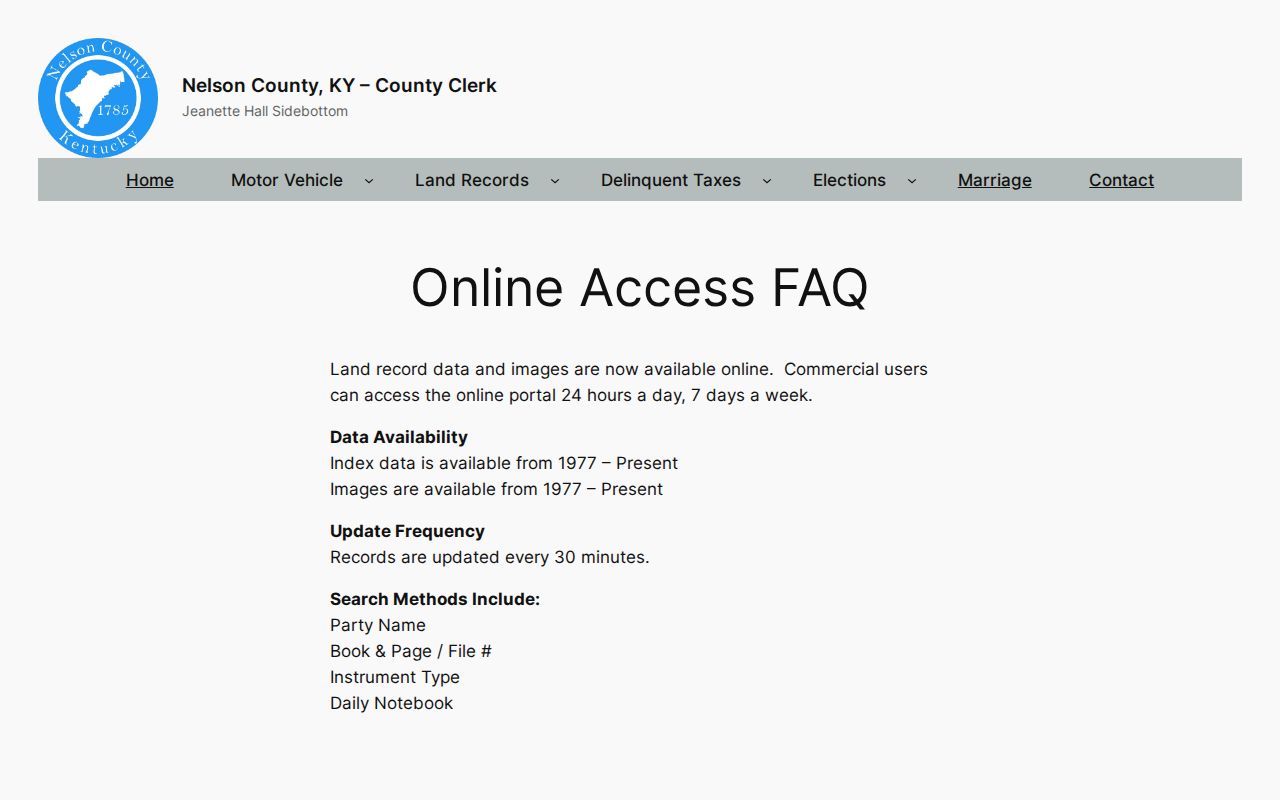
That published boundary tells a former-owner researcher when to leave the web and request the older physical index. Older Nelson County deed records live elsewhere.
Online cutoff. The public web index begins in 1977; earlier former owners must be checked through deed books, microfilm, clerk assistance, or archives.
Reconstruct the Nelson County Deed Chain in Reverse
The clerk publishes four search modes. Party Name, Book and Page or File Number, Instrument Type, and Daily Notebook are the confirmed routes. Use Party Name for a former-owner hunt. Each deed itself establishes who was grantor and who was grantee.
- Find the newest deed for the current parcel and verify the legal description. Record its date and book/page or file number.
- Read the grantor, the party who transferred the interest, and search that exact name among earlier records.
- Locate the deed in which that former owner appeared as grantee. Match the same land before accepting the link.
- Repeat the process until the chain reaches 1977, then continue in the older clerk index and deed books.
- Grantor
- The party transferring the interest stated in a deed.
- Grantee
- The party receiving that stated interest.
- Chain of title
- The linked sequence of recorded ownership transfers for the same land.
- Reverse index
- An index organized to help trace parties backward by role and name.
- Warranty versus quitclaim
- Different deed forms whose legal effect must be read from the instrument, not guessed from the index.
Preserve Every Nelson County Book, Page, and File Citation
Street addresses make weak anchors. Road names and house numbers shift. The deed citation and legal description form a durable trail through Nelson County property records. At every step, save the recording date, deed type, party spellings, book and page or file number, and the land description. The Nelson EZ document search opens the recent chain.
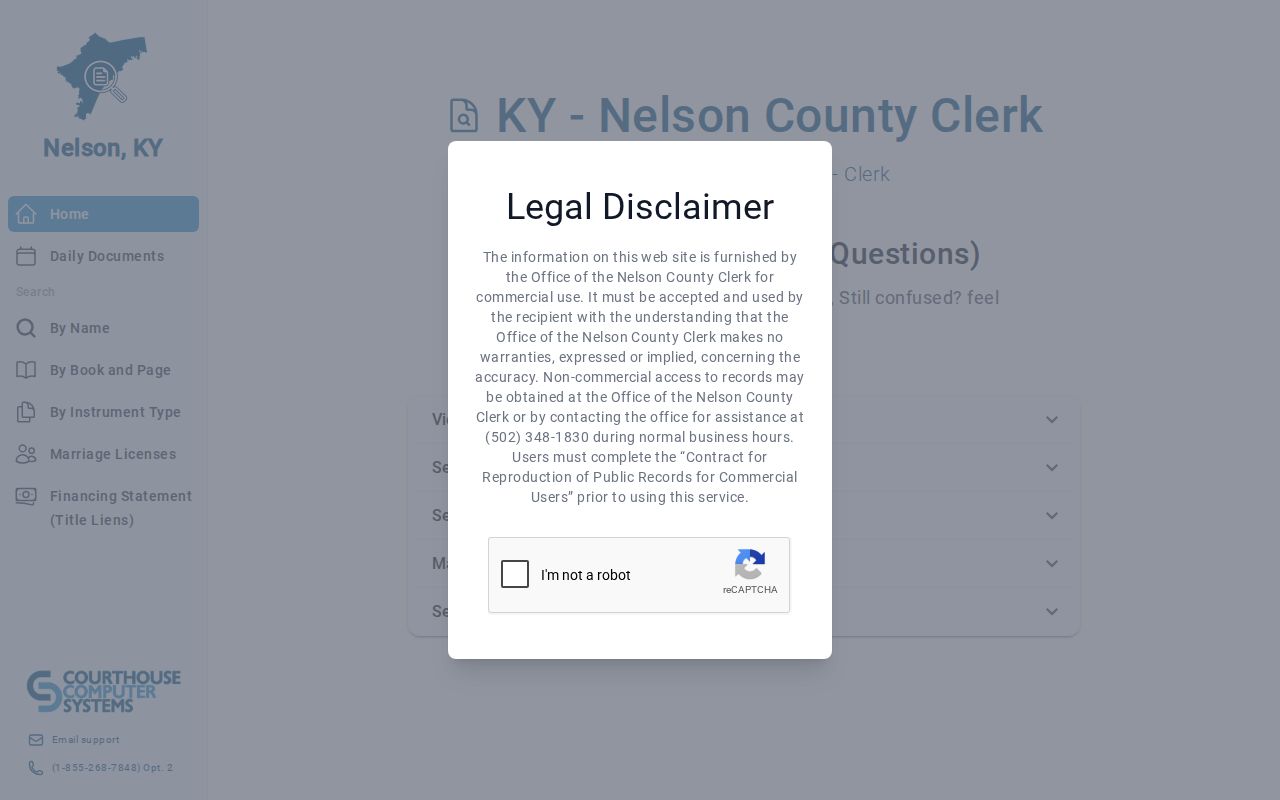
The portal starts the recent chain. It cannot replace reading each deed. Once the history crosses the 1977 cutoff, the clerk holds the rest of the Nelson County property records.
Note: EZ also covers marriage and financing-statement searches, and Premium adds delinquent-tax access, but neither changes the 1977 land-record start.
Follow Nelson County Estate and Court Transfers
Death interrupts many chains. A will, probate inventory, court order, or commissioner's sale notice can name the prior owner before any later deed moved the parcel. Link the authority record to the deed. Never skip the estate step.
Estate cases begin with the Circuit Court Clerk at the Justice Center. CourtNet supplies statewide public case information. A death certificate can confirm identity. It transfers no land by itself. The recorded executor, commissioner, or survivorship deed remains the critical land link.
Central Kentucky death records and historical indexes can aid identification for personal estate research. Match them to the probate authority first, then to the recorded transfer.
Go Back Through Nelson County Books and Microfilm
The clerk at 113 E. Stephen Foster Avenue, Bardstown, is the first source for the exact pre-1977 index and book run. Published telephone service is 502-348-1820. Ask whether the needed volume is onsite, on microfilm, or available through a partner before traveling.
If a volume or finding aid has moved beyond the office, the Kentucky Department for Libraries and Archives research room is a documented fallback. KDLA's statewide deed-record handout covers broad Kentucky deed-book context, but it does not establish Nelson County's exact book letters or digitization years.
The KDLA research-room page shows the archive access point for holdings that require an onsite or staff-assisted search.
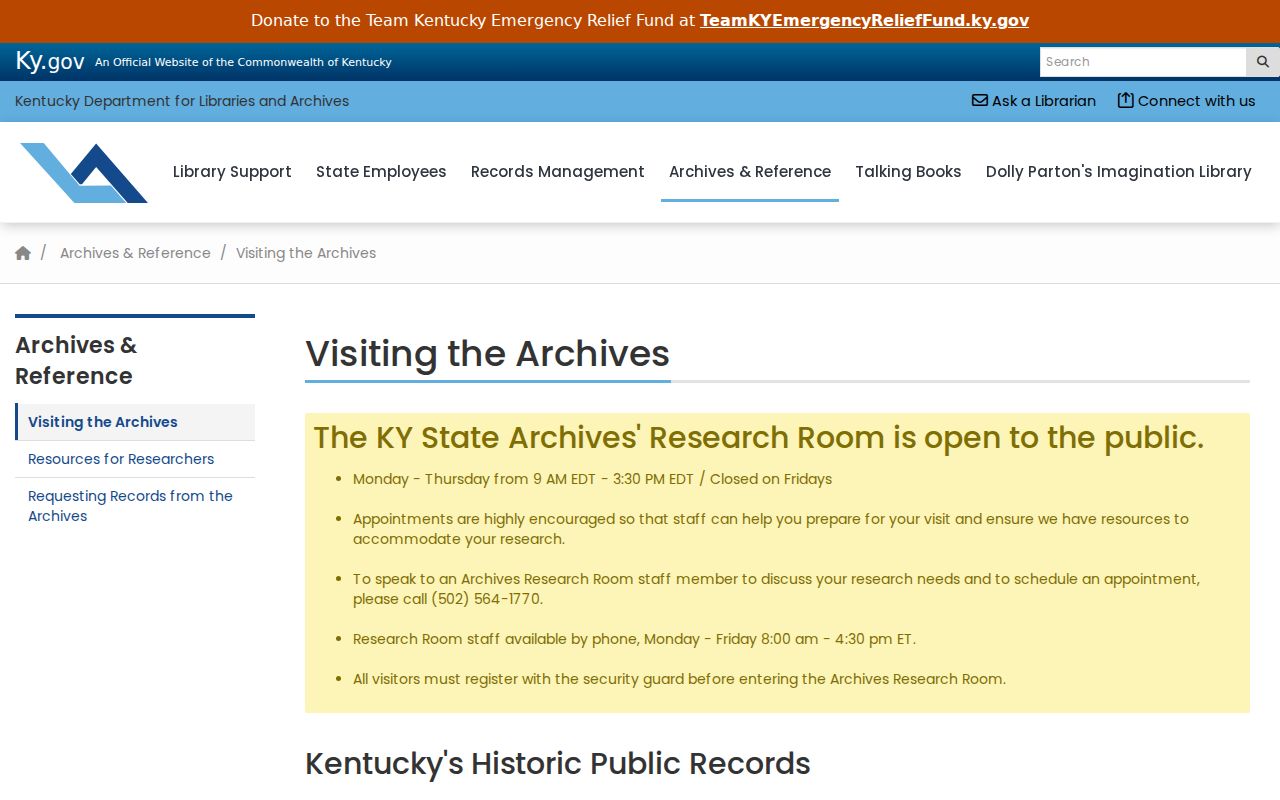
The archive route extends the method. It is not a promise that any Nelson County deed book is digitized there. The Nelson County Public Library main branch, the Kentucky Historical Society, and the FamilySearch Catalog help locate directories. They also surface newspapers and historical sources. Confirm any catalog entry first. Only then treat a Nelson County deed volume as online.
Cross-Check Nelson County Former Owners in Old Notices
Old newspapers can carry you across a stubborn gap in ownership. The Bardstown Gazette ran estate notices, sheriff sales, tract descriptions, and adjoining-owner names. Other Kentucky papers did the same. The Library of Congress holds runs and finding aids that point to likely titles. Treat these items as supporting evidence. They are no substitute for the deed record itself.
New Haven offers a useful wrinkle. Older notices may call it "Pottinger's Landing." That was the settlement name from its 1820 founding. Incorporation came in 1839. Search both names once your parcel history reaches that era. Then lock the chain down with the legal description and recorded citations.
Use Nelson County Land Descriptions When Addresses Changed
Addresses change more often than land does. A recorded plat may show the original lot pattern. A JCCPC permit report can tie a newer street or subdivision to a PVA number. Lot and block references, acreage, metes-and-bounds calls, and adjoining-owner names often survive long after an address disappears. Subdivision names help too.
Never lean on a ZIP code as proof of anything. The 40004, 40008, and 40051 codes are postal clues only. A parcel sitting on a city edge still needs its county deed. It also needs its PVA identity and legal description matched before you call it solved.
Build a Nelson County Former-Owner Research Log
A written log turns a long backward chain into something you can actually audit. Give every possible transfer its own row. Record party spellings and the recording date. Add the deed type, book/page or file number, and any legal-description clue. Note where the source sits. Call a link confirmed only once the land description matches. That discipline keeps a same-name error from spreading through generations of owners.
Offline sources need their own trail. Note the clerk volume, microfilm reel, or archive call number. Or write the newspaper title and issue date. Write down why each rejected item failed, whether a different tract, spouse, or middle initial. A clean negative finding saves as much time as a positive one.
The Nelson clerk's office handles phone and counter questions. A broad party search can flood you with results. If that happens, hand over the last confirmed citation. Ask which older index picks up from that book. For archive work, request a finding aid first. Never assume an online catalog covers the exact county series you need.
Note: A former owner's name counts as evidence only when a deed, court authority, plat, or other reliable source ties that person to the same land.
Know How Far Nelson County Former-Owner Records Reach
Nelson County's published permanent-record date of 1785 sets the outer limit of local depth. It does not promise every parcel chain runs complete to that year. No courthouse fire, missing decade, or restoration project appears in the county's own record. The precise reach of the older indexes is a question for the clerk. State any gap plainly and refer it to the clerk or archive.
A chain can stop for several reasons. The legal description may have changed. An estate transfer may have gone unrecorded, a book may be unavailable, or the parcel may have been carved from a larger tract. Go back to the last proven deed and study its adjoining-owner calls and citations. Ask the custodian which index covers the next era. A surname match alone never fills the break.
Research limit. Former-owner records support house history, estate work, and purchase diligence, but an index chain is not a title opinion and must not be used to harass anyone.