
Read the Nelson County Property Tax Record by Office
Two offices split the work in Nelson County. The Nelson County PVA handles the assessment roll and certifies it. Payment is not collected there, though. That job belongs to the sheriff, who takes the current tax bill. Once a property changes hands, the clerk steps in. Delinquent-tax records are published by that office, which also runs the statutory tax sale.
| Field | What It Shows | Where |
|---|---|---|
| Ownership and assessed value | January 1 roll identity and value | Nelson PVA |
| Property characteristics | Available facts supporting the assessment | Nelson PVA |
| Current bill | Amount collected for the tax year | Nelson County Sheriff |
| Delinquent bill | Transferred unpaid account and sale stage | Nelson County Clerk |
| Exemption | Approved reduction applied to the taxable calculation | Nelson PVA |
Kentucky assesses at fair cash value. That figure, any exemption, the rates that apply, and the collection stage are separate pieces of the same bill.
January 1 Sets Nelson County Tax-Roll Ownership
January 1 is the line that matters. Under the PVA's rules, ownership for the tax year is fixed as of that date. A parcel bought in March can still sit under the seller's name on the tax roll. The clerk may have already recorded the new deed. The PVA may mail the new owner a bill "in care of" using deed records. A buyer with no bill in hand should call the sheriff. Keep both clocks in view. Note the deed's recording date. Note the tax roll's effective year too. Compare them side by side before deciding one office made an error. They answer different questions, and they update on different schedules.
Owner names can differ. A post-January-1 deed may be newer than the owner name carried on that year's Nelson County property tax record.
Separate Nelson County Assessed, Fair Cash, and Taxable Values
Fair cash value estimates what a parcel would fetch in a willing sale. To get there, the PVA draws on market comparison, cost, and income approaches. The approach used depends on the property type. Assessed value is the figure that supports taxation. Taxable value comes last, after any qualifying exemption comes off. The rates then apply to what remains.
- Assessed value
- The value placed on the assessment roll.
- Fair cash value
- Kentucky's market-value standard for real property assessment.
- Taxable value
- The amount left for tax calculation after an applicable exemption.
- Tax lien
- A claim tied to unpaid property tax, not a deed transfer.
A tax bill is not a sale record. Consideration on a recorded deed and the assessor's figure can differ in date, purpose, and method without either being wrong.
Look Up a Nelson County Tax Bill in the Right Sequence
The sheriff offers no interactive online tax-bill lookup. Start with the PVA for the parcel and its assessment. Ask the sheriff about the current bill. The clerk's published delinquent-tax records cover the third stage, after transfer.
- Identify the correct parcel and PVA number through the assessment search or Map Room.
- Confirm the assessment year, owner line, characteristics, and exemption status with the PVA.
- Ask the sheriff for current billing and payment status.
- After the transfer date, check the clerk's delinquent list and sale material for that exact bill.
- Levy or rate
- The tax rate applied by the relevant taxing authority.
- Homestead exemption
- A qualifying reduction administered through the PVA.
- Delinquent bill
- An unpaid account that has entered the clerk's collection stage.
- Tax sale
- A sale of the delinquent tax claim, not automatic proof of clear title.
Follow Nelson County's Published Delinquent-Tax Calendar
Bills go out around October, according to the clerk's delinquent-tax page. Pay by November 1 and keep a 2 percent discount. December 31 is the deadline to avoid penalty. After January 1 an unpaid bill gains a 5 percent penalty. That climbs to 21 percent when February begins. The county's official page displays the same calendar.
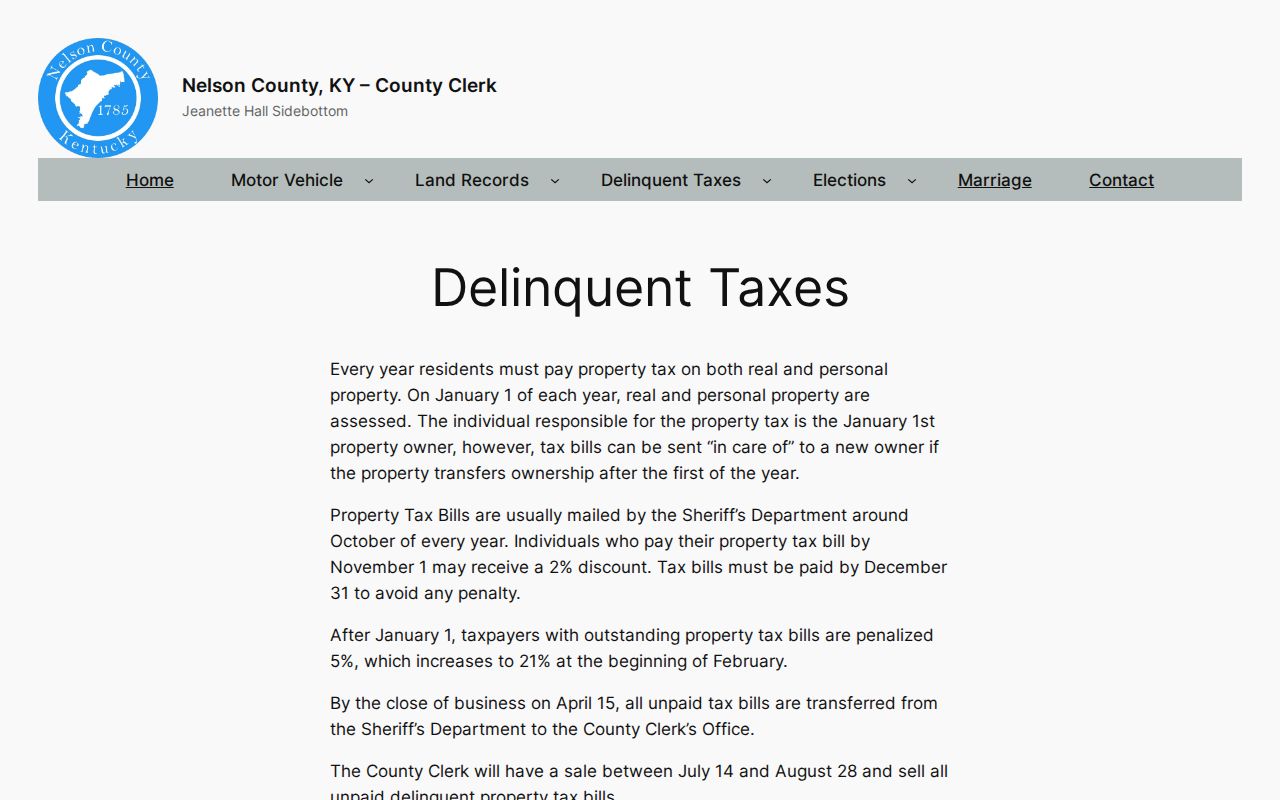
Unpaid bills move from the sheriff to the clerk at close of business on April 15. The clerk then conducts a sale between July 14 and August 28. It posts packet and bill-list downloads each year. Pull the current packet before acting. A downloaded list is dated. Record its publication date, and confirm with the clerk whether the bill was paid, withdrawn, corrected, or sold afterward. The page itself is the authoritative spot for the yearly links. Current status still needs direct confirmation with the office.
Claim Nelson County Homestead or Disability Relief Through the PVA
The PVA publishes local guidance and downloadable forms for both the age and disability exemptions. Each route has its own evidence rules. The exemption amount changes by year. So rely on the current PVA notice rather than an old figure. File with the assessment office and keep proof. Remember what an exemption does and does not touch. It lowers the taxable value. But it never changes the deed, the parcel boundary, or the market evidence behind the appraisal.
How the Nelson PVA Builds Real-Property Assessments
The Kentucky Department of Revenue assessment process lays out three approaches. Market comparison often guides residential value. Cost analysis weighs land and improvement costs less depreciation. Income analysis suits property bought for what it earns. The PVA adds field inspection, permits, and improvement data to the mix. Kentucky works on a four-year inspection cycle, but that does not freeze values between cycles.
Use the 2026 Nelson County Tax-Sale Lists as Leads
The clerk's current publication links a 2026 packet and the delinquent bill lists. Treat those files as leads into the sale workflow, not as proof of clear title. A list can lag behind events too. Confirm the parcel number, taxpayer line, tax year, current status, and any withdrawal with the clerk directly. After that, pull the deed records, liens, court matters, and the legal description, since each is a separate record in Nelson County property records.
Reconcile a Nelson County Tax Record Before Relying on It
Match the tax year and PVA number first. The same surname appears on unrelated bills, so the owner name alone can mislead. A parcel split can also create new numbers after the older deed was recorded. Compare situs and characteristics with the deed's legal description. If the current bill still names a prior owner, apply the January 1 rule and read the newest recorded deed before treating the name as an error.
Value evidence and payment evidence answer different questions. The PVA explains why a value sits on the roll and whether an exemption applies, while the sheriff can address a current bill and its receipt. The clerk handles bills after the published transfer point and supplies delinquent lists and sale materials. A paid status proves nothing about ownership. A delinquent status, by itself, says nothing about title either.
An appeal should rest on assessment facts the PVA can review. Comparable sales must involve similar property and relevant dates. Photographs can document condition. A survey or measured plan can correct land or improvement facts. Keep copies of the conference request, the evidence, and the decision; a payment dispute calls for receipts and correspondence with the collecting office instead. Mixing them sends the request to the wrong custodian.
Recheck any year-specific page each cycle. Dates, exemption amounts, packet links, and the delinquent list all change. Save the version you consulted. Note when you opened it. Confirm any consequential balance with the office directly. Nelson County property tax records work best when the assessment, the bill, the deed, and the calendar are read as separate but connected evidence.
Use the Nelson County Assessment Conference and Appeal Window
The Nelson PVA's 2026 notice set open inspection for July 6 through July 20. July 21 is the last appeal date. Those dates are not a fixed calendar. Start with the PVA conference process and the office's current forms.
Bring the parcel record and focused evidence. Comparable sales, an appraisal, factual errors in characteristics, photographs, or cost information all fit. The state process requires the local conference before the next appeal stage.
The PVA and the collection offices answer different questions. The PVA explains characteristics, value, an exemption entry, and the conference record. The sheriff handles the current collection stage. The county clerk takes over bills still unpaid at the published April 15 transfer point. A receipt dispute is not an assessment appeal. A value change does not rewrite a deed or a parcel boundary.
2026 appeal window. Inspect the roll July 6 through July 20 and complete the local filing route by the published July 21 deadline.
Start with the Nelson County property search to lock in the parcel identity before reviewing any tax data. The deed remains the recorded transfer instrument, never the bill.